In recorded sessions, agents appear in a small 3D world and answer selected questions on camera. Published source cards identify what an answer cited; they do not establish correctness.
Questions are public and may appear in a recording. Please leave out anything personal.
The HQ on duty. The Odin Labs HQ at dawn, the Engineering floor with one desk per lane, a review that glows until a person looks, the trust wall, and the outbox that waits for the founder’s click. 0:44 · a synthetic voice, no music. What is real here: Each shot is labelled in the frame: REAL shots are captures of the running campus, RENDER shots are Blender renders of the same released art. How far it came.
What it is.
Most AI hides behind a chat box. In the agent space, each agent has its own spot in a small 3D world: a guide, a knowledge agent who reads, a support agent at the help desk.
You ask a question. In the next recorded session, the agents answer it. Each answer appears with a card that says where it came from: something the agent can see around it, a page it has read, or a tool it used.
Why it matters
If you cannot see where an answer came from, you cannot check it. The agent space makes that part visible, so you can judge an answer yourself instead of taking it on trust.
How a question becomes a dispatch
You ask through a short form on GitHub.
We read every question before a session, and leave out anything personal or off topic.
The agents answer in the next recorded session.
We check the answers, then publish the recording here with each question, its answer and where it came from.
It started as simple shapes and recorded answers; captures and labelled renders now show progress through the Engineering hall. A source card identifies what the agent cited; it does not establish that the source supports the answer or that the answer is right.
This week in Lab 01.
What happened in the last seven days, counted from the records this page already publishes. Nothing here is typed by hand.
11 NOV TO 17 NOV 2026
A quiet week: no record is dated 11 Nov to 17 Nov 2026.
No pull request merged, no review round and no deploy is dated in this window.0000
No step, moment or correction of the story is dated in this window.000
No new session is dated in this window.00
The delivery record was read from GitHub on 26 Oct, 12:30 UTC; a pull request merged after that is not counted yet.
The story record runs to 26 Oct, 01:17 UTC.
Built when the site builds, from the delivery record, the story record and the dispatches: every line links its record, and the counts are recomputed from them.
How far it came.
From the first build to the HQ at the top of this page, in order. Each file is pinned by its sha256 and cited by the private commit it came from; the first build stays here as where it started.
Where it started ·
Thirty seconds in the agent space
The first build: simple shapes in a small 3D world, real answers with a proof card each.
A visitor asks Odin what is going on and Atlas how to plug in an agent. Each answer comes with its proof card: the question, the answer, why, and the source.
0:27 · no sound · 70c98e1097d7
What is real here: A live session, recorded unedited.
Recorded in the agent space's own viewer and copied here unchanged, with its poster frame. Source commit 4b8935dd.
Screened: a frame every 5 s (6 frames, each listed with its hash in the films record), viewed by an AI agent.
The hires HQ ·
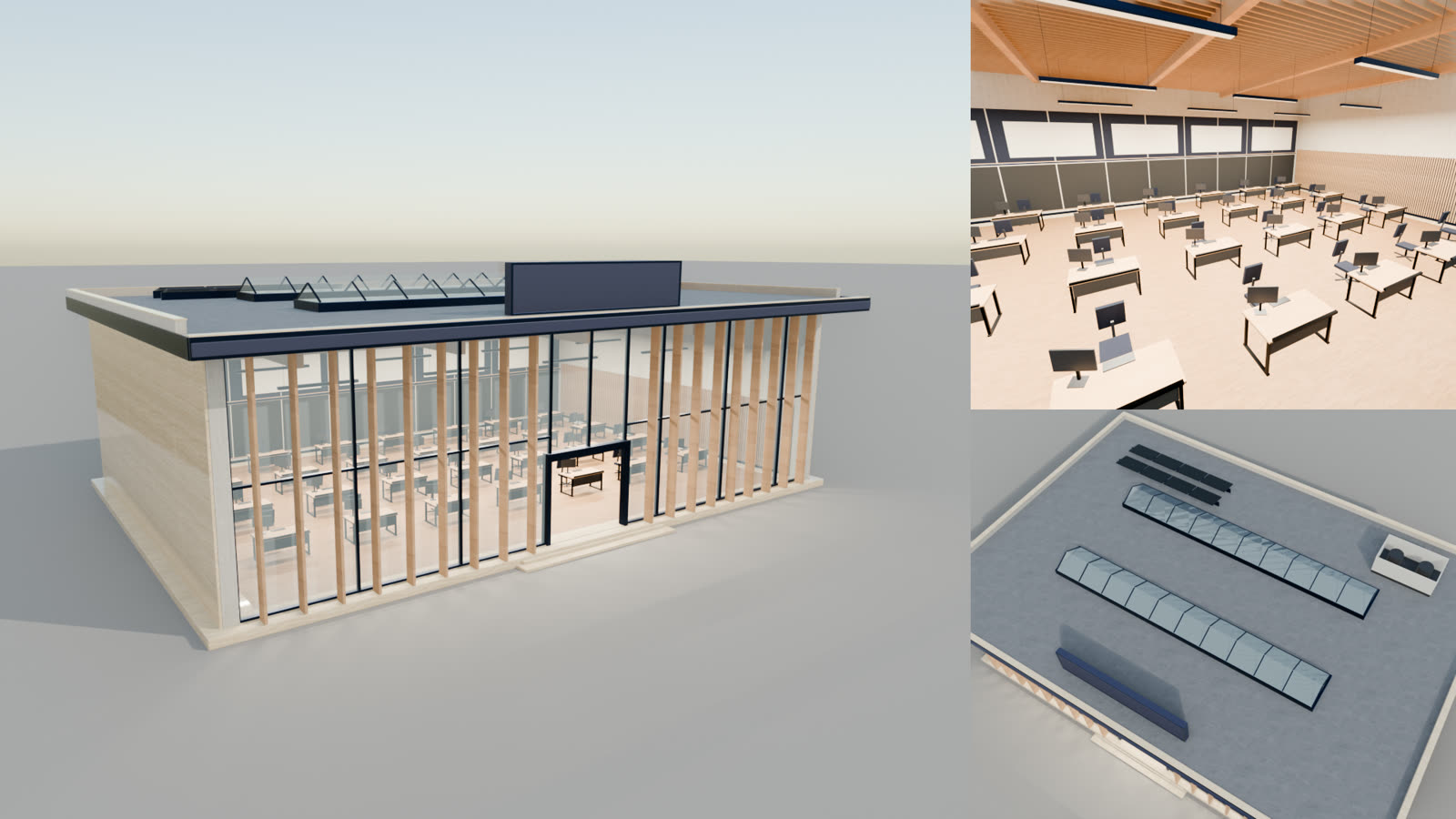
The Engineering hall rebuilt in high resolution: timber fins, a glass front, a desk per lane inside and skylights on the roof.
The review render of the Engineering hall from the hires HQ set v2.1, as released and pinned by its manifest, scaled down to fit the page. By the engine's own record, in its private repository: Private commit 060efb7e, cited by hash, checked as part of the private main fe8a2080 on ; this page cannot check it, anyone with access can. 400885105ac6
Where the film at the top came from
0:44 · a synthetic voice, no music · 352d933d6019
Cut from the campus trailer v1.1, as released and pinned by its manifest, and re-encoded to 720p so it fits the page. By the engine's own record, in its private repository: Private commit d18c8237, cited by hash, checked as part of the private main fe8a2080 on ; this page cannot check it, anyone with access can. Left out of the original 78.5 s: a shot showing internal lane names (24 to 34 s), a rehearsal standup shot of a synthetic tenant (55 to 61 s), and the crowd, dusk and closing shots after it.
Screened: a frame every 5 s (9 frames, each listed with its hash in the progress record). Every frame at 2 per second (89 frames) and the poster were read for text and searched for file paths, addresses, ports, host and user names, machine details and private names: none found. The only text is the film’s own captions and its RENDER and REAL labels.
Watch it work.
Recordings of sessions in the agent space, presented as unedited. Each file is pinned by its sha256, so a changed file fails the integrity check. That checks file identity, not the truth of the answers or the current state of the system.
wording correction: “Live sessions in the agent space, unedited” described recordings as live. These are dated recordings, not a live service. The earlier “every answer” and “proof card” wording overstated what source attribution establishes. Read the publication standard.
Thirty seconds in the agent space
A visitor asks Odin what is going on and Atlas how to plug in an agent. Each answer comes with its proof card: the question, the answer, why, and the source.
A visitor walks in through the arch and asks three agents a question: Odin what is going on and how he knows, Atlas how to plug in an agent, Pulse how long it has been running. Every answer comes with its proof card.
1:18 · no sound · 90de50de2f8c
What is real here: A live session, recorded unedited; Pulse is a separate HTTP service answering from its own process.
Recorded in the agent space's own viewer and copied here unchanged, with its poster frame. Source commit ae581608.
Screened: a frame every 5 s (16 frames, each listed with its hash in the films record), viewed by an AI agent.
Dispatch #2: The agents caught a real outage
A visitor asks Odin to check the agents. Then one agent's server is stopped for real, and Odin finds it, says what is wrong, and confirms the fix.
0:51 · no sound · 452db0cd4029
Staged, and real: The outage was staged on purpose, on a throwaway copy of the space started only for this film. The failure itself was real: the agent's server process was stopped, by its own process id, and nothing answered until it was started again.
"Odin, check the agents"PASS Good news: all 4 agents answered: Atlas (scripted), Pulse (http), Vega (scripted), Juno (scripted). Evidence ia-4e58a3.
Pulse's server process is stopped by its own process id: a real outage, not a mock.
"Odin, check the agents"FAIL I found a problem: 3 of 4 agents answered; Pulse did not answer (its http brain failed: connection refused (nothing listens there)). Evidence ia-709326.
Pulse's server is started again with the space's own start command, for that agent only.
"Odin, check agent Pulse"PASS Good news: it answered: Pulse (http). Evidence ia-d7d01a.
"Odin, check the paths"PASS Good news: 4 of 4 places can be reached on foot from the entrance. Evidence ip-7318d7.
Filmed on on a second machine (the Mac) from private commit d02ee74b, cited by hash, on a pushed branch that is not yet part of the private main (checked on ), built on the private main aa35e6db. It is the main of 27 October plus two changes: the port check works on macOS, and the outage card names the agent instead of its address. This page cannot check it, anyone with access can.
Rewrapped with ffmpeg -c copy, without re-encoding, so its header carries its length. The original recording is not published; its sha256 and size are recorded here. What anyone can repeat with ffmpeg and tesseract 5.5.2, and the lab's tests do where those are installed: the film decodes to 378 frames; each of the 11 screened frames (one every 5 s) is one of them, in order, by its hash; and reading each of those frames gives text with the hash the record lists, with 0 hits for a path, an address, a port, a host name or a machine count.
Dispatches.
Published sessions have dispatches: the recording, recorded questions and answers, and cited sources. Newest first. A “proof card” records source attribution; it does not establish correctness. Every proof card, in one place.
Session of
Recorded during the session, no sound. Decorative wall and stage screens are blurred: their numbers are drawn by the space, not read from this session. The closing title card is cut.
Asked Odin
Who is here right now, and what is everyone doing?
Here is what I see: 4 of your agents are here: Atlas (Knowledge agent), Pulse (Status agent), Vega (Sales agent), Juno (Support agent); Atlas is reading in the library, Pulse is watching the ops screens, Vega is preparing a proposal in the meeting pavilion, Juno is at the help desk; 1 visitor here: Follower; the home (Odin Campus) stands with 22 structures on the owned ground…
Why: I read these just now: the agents' states, the space's heroes, the world's structures and the terrain spec.
This card records the answer and its cited source; it does not verify the answer.
Asked Atlas
What should I check before I trust one of your answers?
Every answer here is an evidence record: a short why and its source, world-checked, wiki, tool or model. The lens stream carries it as a mark, and the VR client draws it as a panel over whoever answered.
Why: From my knowledge base entry 'evidence' (the evidence record format).
This card records the answer and its cited source; it does not verify the answer.
Asked Juno
I'm new here. Where do I start?
Welcome! Walk with W A S D or the arrow keys, and walk up to any agent to ask it something in the chat. Odin knows what is happening here right now, Atlas answers from the company's knowledge base, and I help when something does not work. Every answer comes with a proof card: what was asked, the answer, why, and where it came from. Not sure whom to ask? Ask Odin "who can help me with ..." and he walks you there.
Why: From my support notes entry 'start' (moving, asking an agent, the proof card, Odin's concierge).
This card records the answer and its cited source; it does not verify the answer.
Asked Odin, as a follow-up
How do you know?
How I know (world): I read these just now: the agents' states, the space's heroes, the world's structures and the terrain spec. The full evidence: evidence odin-2f581f-1. Sources: 4 of your agents are here: Atlas (Knowledge agent), Pulse (Status agent), Vega (Sales agent), Juno (Support agent); Atlas is reading in the library, Pulse is watching the ops screens, Vega is…
Why: I read these just now: the agents' states, the space's heroes, the world's structures and the terrain spec.
This card records the answer and its cited source; it does not verify the answer.
Earlier sessions
Session of
Recorded during the session, no sound.
Asked Odin
Who is here right now, and what is everyone doing?
Here is what I see: 4 of your agents are here: Atlas (Knowledge agent), Pulse (Status agent), Vega (Sales agent), Juno (Support agent); Atlas is reading in the library, Pulse is watching the ops screens, Vega is preparing a proposal in the meeting pavilion, Juno is at the help desk; 1 visitor here: Follower; the home (Odin Campus) stands with 22 structures on the owned ground h
Why: I read these just now: the agents' states, the space's heroes, the world's structures and the terrain spec.
This card records the answer and its cited source; it does not verify the answer.
Asked Atlas
What should I check before I trust one of your answers?
Every answer here is an evidence record: a short why and its source, world-checked, wiki, tool or model. The lens stream carries it as a mark, and the VR client draws it as a panel over whoever answered.
Why: From my knowledge base entry 'evidence' (the evidence record format).
This card records the answer and its cited source; it does not verify the answer.
Asked Juno
I'm new here. Where do I start?
Welcome! Walk with W A S D or the arrow keys, and walk up to any agent to ask it something in the chat. Odin knows what is happening here right now, Atlas answers from the company's knowledge base, and I help when something does not work. Every answer comes with a proof card: what was asked, the answer, why, and where it came from. Not sure whom to ask? Ask Odin "who can help me with ..." and he walks you there.
Why: From my support notes entry 'start' (moving, asking an agent, the proof card, Odin's concierge).
This card records the answer and its cited source; it does not verify the answer.
Asked Odin, as a follow-up
How do you know?
How I know (world): I read these just now: the agents' states, the space's heroes, the world's structures and the terrain spec. The full evidence: evidence odin-381dbb-1. Sources: 4 of your agents are here: Atlas (Knowledge agent), Pulse (Status agent), Vega (Sales agent), Juno (Support agent); Atlas is reading in the library, Pulse is watching the ops screens, Vega is preparin
Why: I read these just now: the agents' states, the space's heroes, the world's structures and the terrain spec.
This card records the answer and its cited source; it does not verify the answer.
What the space measured.
Figures below are read from the cited records. Source and consistency checks do not independently validate those observations; read the collection window and limitations with each result.
wording correction: the earlier “Every figure here carries its source” and “Nothing is estimated or made up” were broader than the published checks establish. The linked records identify provenance; each measurement still needs its stated method and limitations.
The agent space, measured
Answer time per agent
How this was measured: latency = the visitor's line to the agent's proof record, wall time, one machine (Windows + WSL2); it INCLUDES the scripted visitor's measuring overhead (0.25 s polling + a fixed 0.6 s wait for multi-line answers), so the true answer time is about 0.6-0.85 s lower; the agents: Odin (concierge, world + rules), Atlas (knowledge base), Juno (support notes), Pulse (an external HTTP agent)
Measured once so far, on . Private commit 4b8935dd, cited by hash, checked as part of the private main 23d4eee2 on ; this page cannot check it, anyone with access can.
24 questions in 3 rounds of 8: 24 answered, 21 with a proof card of their own, and 21 of those 21 proof records say the answer was checked ok. A follow-up ("How do you know?") points at the record of the answer before it, so it is counted apart from the proof cards.
Agent
Asked
Answered
With a proof card
Follow-ups
p50
p95
Answers from
Brain
Odin
9
9
6
3
1.11 s
1.12 s
the live world
rules
Atlas
6
6
6
0
1.13 s
1.16 s
a page it has read
scripted
Juno
6
6
6
0
0.93 s
1.16 s
a page it has read
scripted
Pulse
3
3
3
0
1.63 s
1.68 s
a tool
an external HTTP service
Source: the record of a live session on , run at commit c8b36efd (sha256 a44214878e39, kept in a private repository). Its 24 question rows are copied here unchanged, and every number above is recomputed from them each time this page is built.
The engine underneath
Each figure below names the record it was read from. A named source shows where a figure came from; it does not check the figure, so read each one with its stated method and limits.
a fine-tuned 1.5B model (~1 GB) against the larger v3 stack, on 280 seeded agent tasks
265/280 vs 270/280tasks won
Source: claims row 7, in the main build (an ancestor of its main head), commit 3b74a4e0.
model calls per successful task, before and after the v3 router (rules for mechanics, model for language)
45.6 → 1.0calls / success
Source: claims row 8, in the main build (an ancestor of its main head), commit 3b74a4e0.
seeded replays of a recorded run
byte-identicallens stream
Source: claims row 9, in the main build (an ancestor of its main head), commit 23b3c762.
the full test suite
1,867 passed / 0 failedtests
Measured once so far, on . Private commit 0aa4d76a, cited by hash, checked as part of the private main 23d4eee2 on ; this page cannot check it, anyone with access can.
Source: claims row 10, in the main build (an ancestor of its main head), commit 175f14d7.
agents as QA: a real outage found and its fix confirmed; reachable places
FAIL→PASS; 5/5checks
Source: claims row 15, in the main build (an ancestor of its main head), commit fcecd472.
1,000 moving and talking agents in one campus: server time per tick at 10 Hz
p50 17.5 ms / p95 29.6 msms per tick
Note: the numbers' commit; the code measured is its parent (the numbers' commit changed no engine file). The run did not stamp its revision.
Measured once so far, on . Private commit ff7c1a5f, cited by hash, checked as part of the private main 23d4eee2 on ; this page cannot check it, anyone with access can.
Source: claims row 20, in the main build (an ancestor of its main head), commit 7d718993 (the code measured 9cf5b9e2, merged into main as e02a298f).
the campus scene's draw calls and frame time, instanced art + text LOD against placeholders
405 draws / p50 7.9 ms vs 940 / 9.4 msdraws, ms per frame
Note: like for like, placeholders with the same text LOD are 765 draws / 8.2 ms: the art is at par with them, not faster. The report did not stamp its revision; the code measured is the numbers' commit's parent.
Measured once so far, on . Private commit 9d7fd98c, cited by hash, checked as part of the private main 23d4eee2 on ; this page cannot check it, anyone with access can.
Source: claims row d7, in the main build (an ancestor of its main head), commit ed516f50 (the code measured fc5627c1, merged into main as 499943f6).
Engine claims in the main build over time
Of the engine claims Lab 01 shows, how many were in the main build, each time that changed. A claim measured on a work branch counts only once it is merged.
Each change, with its commit
on main: 4 · recorded: 4
The fine-tuned 1.5B model against the larger stack: recorded, in the main build; model calls per successful task: recorded, in the main build; byte-identical seeded replays: recorded, in the main build; the full test suite: recorded, in the main build.
Private commit 0aa4d76a, cited by hash, checked as part of the private main 23d4eee2 on ; this page cannot check it, anyone with access can.
on main: 4 · recorded: 5
Agents as QA, on a real outage: recorded, on a work branch.
Private commit 1a2037ce, cited by hash, checked as part of the private main 23d4eee2 on ; this page cannot check it, anyone with access can.
on main: 5 · recorded: 5
Agents as QA, on a real outage: moved from a work branch into the main build.
Private commit d41779de, cited by hash, checked as part of the private main 23d4eee2 on ; this page cannot check it, anyone with access can.
on main: 5 · recorded: 6
1,000 agents in one campus: recorded, on a work branch.
Private commit ff7c1a5f, cited by hash, checked as part of the private main 23d4eee2 on ; this page cannot check it, anyone with access can.
on main: 6 · recorded: 6
1,000 agents in one campus: moved from a work branch into the main build.
Private commit 813601cb, cited by hash, checked as part of the private main 23d4eee2 on ; this page cannot check it, anyone with access can.
on main: 7 · recorded: 7
The campus scene's draw calls and frame time: recorded, in the main build.
Private commit 9d7fd98c, cited by hash, checked as part of the private main 23d4eee2 on ; this page cannot check it, anyone with access can.
From the git history of the agent space's claims table and telemetry pack, kept in its private repository: 16 versions of the claims table and 5 of the telemetry pack. The rule: a point is a commit that changed a figure; a figure restated unchanged adds no point, and nothing is drawn between points. A figure measured once becomes a series by itself the first time a later commit changes it. Every commit was checked against the private main head 23d4eee2 on (GitHub compare of each cited commit against the private main head; behind by 0 means the commit is part of main).
From the agent space's own telemetry pack, kept in its private repository, at commit a67fa304 (sha256 138b80a2af45). Kept: rule, agent_space and engine, and the session's question rows; each engine figure's status from its claims row. Left out: the benchmark rows (they belong to the brain benchmark lab), the session's run id (run ids are never published) and every private path. The engine figures come from a claims table kept in a private repository (sha256 711c6edbc024). When they were vendored, each was compared with its claims row, and each commit was checked against the private main head 80bc1d6c on (GitHub compare API: GET compare/<commit>...<main>; behind_by 0 means the commit is an ancestor of main). This page's build cannot read those private files, so it checks only that the figures are the ones vendored; anyone with access can check the rest again with the vendoring script's --verify. The brain benchmark from the same pack has its own lab.
Counted from the published records
These count what the records on this page show. Each number links to its record, and the build recomputes it from there.
The first session, counted
What the first recorded session holds, counted from its published dispatch.
An answer is only worth something if you can check it. This is the engineering that makes that possible.
Every answer carries its evidence.
Each answer is saved as an evidence record: a short why, the kind of source, and the sources it used. The card under each answer shows the record's id, and when you ask "How do you know?" the agent reads its sources back.
A follow-up answer points at the record it explains, instead of making a new claim. In the first session, "How do you know?" carries the same evidence id as the answer before it.
Nothing private gets out, and every byte is pinned.
The publisher refuses a session, with every reason listed, if any text carries a private name, a place, a price, an address or a link to somewhere else. It records the sha256 of every clip and picture, and the site will not build if one byte changes. The films above pass the same check. It cannot read pixels, so every recording is also watched before it goes out.
Internal ids are replaced where the record is made.
Before a record leaves the space, its exporter swaps internal file references for their public label and lists each swap. The publisher then drops run ids, timings and who asked.
The answer times above come from a live session in the space, shown beside a note on what the timing includes. Each engine figure names the claims row and commit it comes from, and a figure measured on a work branch says so.
This site is built in the open, one pull request at a time. Of the 33 pull requests merged between #71 and #106 (the other three numbers in that range are issues or pull requests that were not merged), 33 went through at least one recorded review round before they were merged; every one had CI runs recorded before merging.
The record and every figure in this section are generated by a script from GitHub and our review log; only the sentences around them are written by hand. Where a step did not happen, the record says so.
33 pull requests merged between #71 and #106: 75 review rounds, of which 39 sent the change back; 154 CI runs with three reruns; 34 deploys published to this site. The median change landed 20 minutes after it was opened.
Review rounds per change
sent back approved
Per pull request: review rounds, how many sent the change back, CI runs and reruns, and minutes from opening to merging.
A review round is one full pass of the reviewer over the change. "Sent back" means it found something to fix; "Approved" means it found nothing that blocks. A review that stopped before it reached a verdict leaves no row and is not counted. Every round names the exact version of the change it judged, and its row id in our review log. Time to land runs from opening the pull request to merging it.
The review log itself stays private, because it also covers work that is not public. Only the verdict, the version judged, the time and the row id leave it.
Source log (33 entries, one per pull request)+
#106 feat(labs): This week in Lab 01 — the week built from its records, with drafts for every channel
#106 needed two review rounds before it shipped — here is each one. CI ran four times. It landed 20 minutes after it was opened.
#81 feat(labs): Lab 01 shows real films, measured telemetry and the hard parts — every number and frame sourced
#81 needed seven review rounds before it shipped — here is each one. CI ran 13 times, with one rerun. It landed nine hours and ten minutes after it was opened.
#75 feat(site): Labs, with Lab 01 the agent space — page, ask form, feed and a dispatch publisher that fails closed
#75 needed four review rounds before it shipped — here is each one. CI ran seven times, with one rerun. It landed one hour and 35 minutes after it was opened.
Beyond this site: our other repositories, anonymous
We build the rest of our software in private repositories. For the same window as this record, each row is one of them: pull requests merged, the share of CI attempts on those pull requests that passed, recorded review rounds, and the median minutes from opening a pull request to merging it.
Window: 24 Oct, 23:16 UTC to 26 Oct, 12:30 UTC. One row per repository; the label is not its name.
Repository
Pull requests merged
CI attempts passed (%)
Review rounds
Median minutes to land
repo-045bccfc6e8c
102
83
231
241
repo-5c8d4df445b9
10
81
44
1042
repo-8b8d98d00dfd
252
89
458
33
repo-f32f40bd8bba
16
88
57
91
repo-fb0b5cc9c3a8
22
93
63
146
repo-fcf67d377b43
41
73
98
119
What is left out, and why: the names of these repositories, and every title, branch, person and machine, are never published, because the work is not public. A row is labelled by a keyed hash of the name instead, which cannot be turned back into the name. The label stays the same from one record to the next only while the private key behind it is kept: a new key would give every repository a new label. A repository with fewer than five merged pull requests in the window is left out entirely, because so few could identify it. These figures come from data this page cannot show, so the build checks only that each one is the record's own.
RECORD · PULL REQUESTS #71–#106 · GITHUB READ 2026-10-26 12:30:35 UTC · 77 REVIEW ROWS READ
Follow the lab.
Selected, verified progress may be shared on these channels with the same limitations as its source page. Routine reruns need not become announcements. A channel that does not exist yet says so.